
QUARTZ-1 Programmable Monophonic Synthesizer

Proof of Concept
The idea behind the creation of this instrument was to see if it was possible to design and build a programmable analogue synthesizer by myself. All the design elements and techniques I would develop for the QUARTZ-1 would later be used to create a polyphonic programmable synthesizer, which would become the QUARTZ-8.
For easy of build, I chose a standard off-the-shelf 2-unit 19” rack case as the housing for this project. I ended up building 3 of these units, of which one was for a friend. He has made a Kontakt sample pack of this instrument, which you can find here. With this sample pack you play the sounds of this monophonic instrument polyphonically.
Digital Control
The heart of the system is a microcontroller (Arduino Mega) which is tasked with reading the knobs and switched, reading the pots, controlling the LED’s, the LCD and the DAC and sample and hold circuits in order to create all the analogue voltages needed for the analogue circuitry. It also handles all incoming and outgoing MIDI messages. And of course it handles storing and recalling patches.
The modulations are generated entirely digitally by the microcontroller. It generates 2 LFO’s and 3 envelopes. It also calculates all the modulation routings offering a comprehensive set of modulation possibilities.
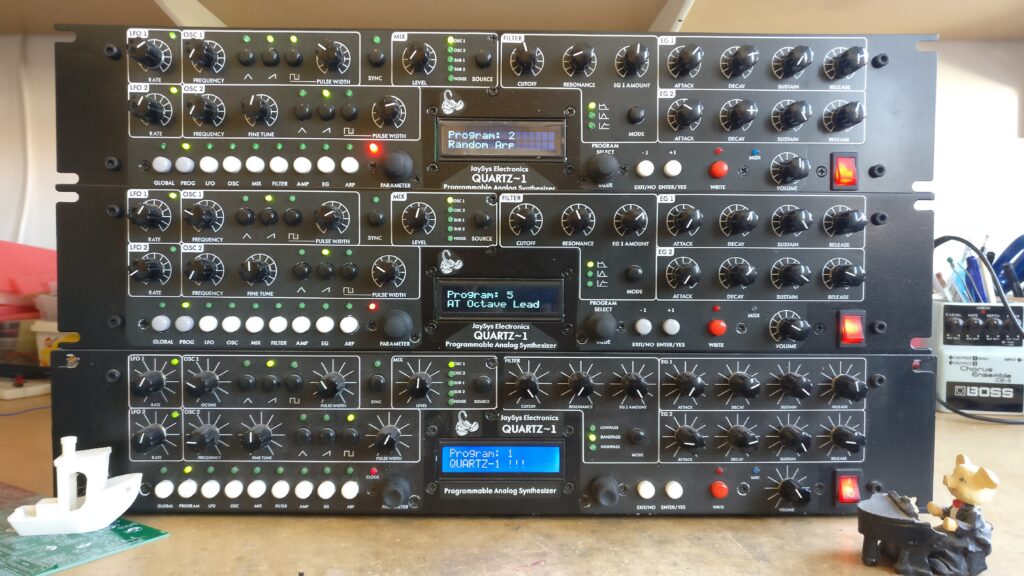

Analogue Signal Path
The analogue signal path starts with 2 3340-based VCO’s, each having it’s own sub-oscillator 1 octave below the pitch of the VCO. There’s also a noise source. The VCO’s can output up to three waveshapes simultaneously: triangle, sawtooth and variable pulse. There’s also analogue FM and hard sync from VCO 1 to VCO 2. These 5 sound sources are mixed and sent to the state variable filter. This OTA-based filter has 4 modes: low pass, band pass, high pass and notch. This resonant VCF is capable of self-oscillation. There’s even audio modulation of VCO 1 to the filter. The signal path ends with a VCA and a panning circuit.